Ignorance. Acceptance. Realization.
When traders hear the word psychology, they reach for the usual list. Fear. Greed. Confidence. Stress. These are real forces. They shape decisions every day in every market.
For systematic traders, psychology operates at a deeper layer. It lives in perception itself. In how a trader sees the market, interprets uncertainty, and responds to what the data reveals. Emotions are symptoms. Perception is the architecture underneath them.
Perception evolves through a repeating cycle that every serious trader eventually recognizes: ignorance, acceptance, realization. Each stage reshapes what the trader sees, what they trust, and how they act.
Before any of it begins, one practice makes the entire cycle possible.
Observation: Where Systematic Thinking Starts
Observation is quiet. It does not rush toward conclusions. It does not predict. It holds attention on reality long enough for patterns to become visible.
Ancient astronomers spent decades watching the sky. Night after night, year after year, recording the position of the moon and the movement of stars before celestial mechanics had a name. Farmers observed seasons for generations before planting cycles were formalized. Engineers study stress patterns in materials before designing stronger structures.
Systematic traders do the same. They watch price movements, volatility expansions, liquidity shifts, regime changes. They watch long before they act.
The reason this matters is fundamental. Without observation, every trading decision becomes speculation. Observation converts randomness into information. And information is what allows a deeper psychological process to begin.
Stage One: Ignorance
Ignorance is the starting position. It carries no shame. It is simply the absence of experience.
At this stage, the market appears easier than it actually is. Patterns look obvious. Strategies look simple. A few profitable trades create the impression that understanding has already been achieved. Predictions feel accurate because small samples reward confidence.
Then complexity arrives. A strategy that worked for several weeks stops working. A high conviction trade moves violently the other way. A series of losses appears exactly where certainty once stood.
Ignorance reveals itself slowly, trade by trade, as the distance between expectation and reality becomes impossible to ignore.
Stage Two: Acceptance
Acceptance is the moment when a trader stops fighting what the market is showing them. This is a difficult transition because the human mind prefers control. It prefers prediction. It prefers certainty.
Markets operate on probability. Acceptance begins when a trader internalizes that survival is the objective. Structure begins to take shape. Risk limits get defined. Position sizing becomes deliberate. Losses transform from emotional events into a recognized cost of operating within uncertainty.
Something interesting happens here. Trading becomes less exciting, less dramatic, less emotional.
Systematic trading often looks boring from the outside. The same process repeated day after day. The same rules, the same execution, the same discipline week after week. Many traders struggle at this stage because boredom feels uncomfortable. The mind searches for novelty, for action, for the thrill of a new idea.
Repetition is where stability comes from. Factories produce reliable output because processes repeat. Airlines maintain safety records because procedures repeat. Scientific experiments generate valid results because method repeats. Consistency emerges from structure. Structure is built through repetition.
Stage Three: Realization
Realization arrives quietly. There is no dramatic turning point. Just a gradual understanding that the system works because it respects uncertainty rather than fighting it.
The search for the perfect prediction ends here. Focus shifts entirely to process. The edge exists in the structure, in the probability math, in the risk management. Small advantages repeated across many trades over long stretches of time. Compounding begins here. The system becomes stronger than individual judgment, and results start reflecting that shift.
Then something fascinating happens.
Realization reveals a new layer of ignorance. The deeper a trader observes markets, the more complexity becomes visible. New regimes. New behaviors. New risks that were invisible at earlier stages. The cycle begins again. Ignorance, acceptance, realization. Again and again, each time at a deeper level.
The Cycle as Operating System
This repeating cycle is what separates perception psychology from emotional management. Emotional control is one skill. Perceptual evolution is the entire operating system.
Consider what happens when a trader has completed the cycle once. Their system is working. Their risk is managed. Their execution is consistent. Then the market shifts. A new volatility regime appears. A correlation that held for years breaks down. A behavioral pattern they relied on becomes crowded and loses its edge.
Complexity was waiting at a depth that the previous level of perception could not reach. This is why the cycle repeats. Each revolution deepens observation. Inside ignorance, observation reveals what assumptions are hiding. Inside acceptance, observation clarifies what structure to build. Inside realization, observation uncovers the next layer of complexity that will restart the cycle.
Observation exists outside the three stages. It is the constant practice that makes movement through them possible. The cycle turns. Observation holds steady.
Alignment Over Conquest
Over time, this process produces a specific kind of transformation. The trader stops searching for the strategy that will finally make everything predictable. They begin building systems that adapt to what observation reveals. The trader and the system become inseparable. Psychology and process become two expressions of the same discipline.
The traders who endure the longest are rarely the ones who believed they had the market figured out. They are the ones who kept observing, kept accepting what the data showed them, and kept evolving through the cycle. Each revolution made their perception more honest. Each deepening made their system more resilient.
The goal was always to align with the market. Alignment means recognizing that uncertainty is permanent and building systems that operate within it. Alignment means treating every loss as information. Alignment means understanding that the trader is the strategy, and the strategy is the trader.
Trading psychology, understood this way, becomes the deepest form of systematic thinking. It is where the mind becomes the system and the system becomes the mind.
This is the truth as I have found it. Your path may reveal more.
Think in odds. Act with discipline.
— Ashim
Visual Breakdown. Video Edition
These lessons are part of my ongoing public research on System R AI.
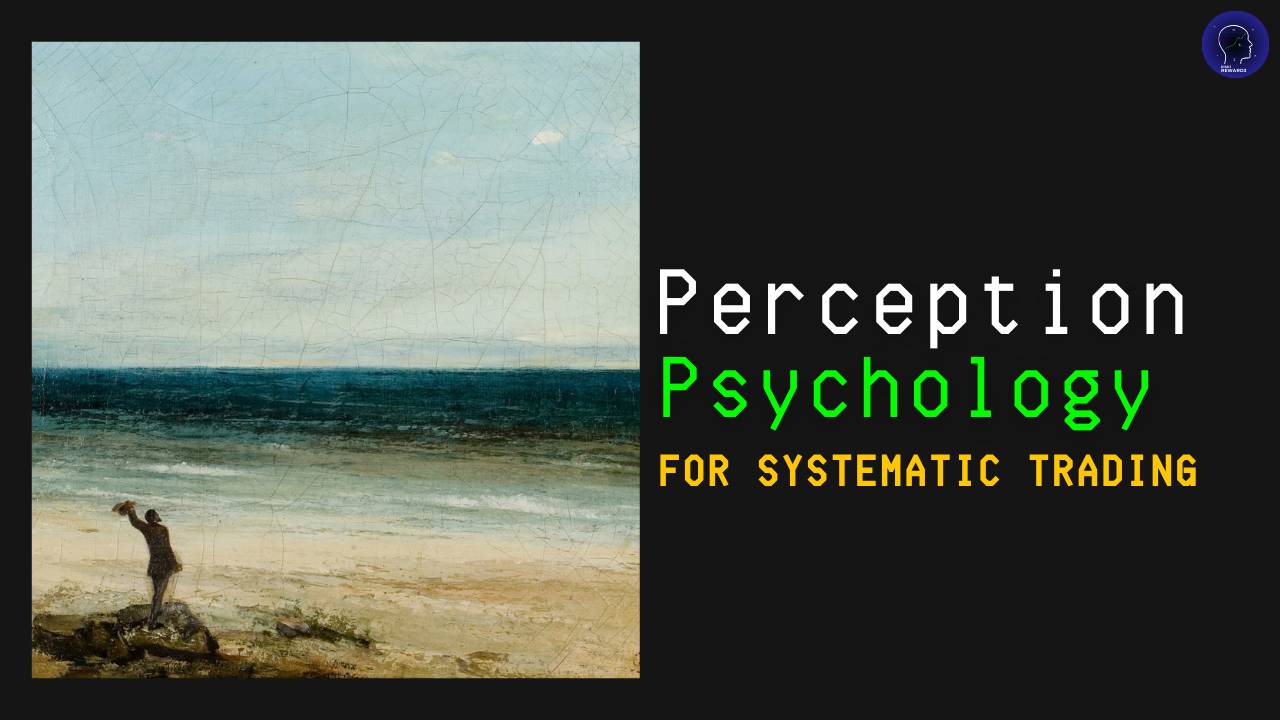
Perception Psychology for Systematic Trading
This video explores perception psychology as the operating system beneath systematic trading. It examines the repeating cycle of ignorance, acceptance, and realization, and why observation is the constant practice that makes the entire process possible.
Watch more: System R AI YouTube
Continue Learning
Related frameworks:
- Risk Management: The Only Edge You Control
- Strategy Design: The Blank Scroll
- Trading Edge: The Advantage That Must Be Earned
- Market Regimes: Adaptation and the Nature of Change
- Volatility and the Nature of Uncertainty
- Probability & Statistics: The Language of Edge
- Capital Management for Systematic Trading: The Discipline of Compounding
- Crisis Management: The Space Between Knowing and Surviving
- Backtesting: The Discipline of Honest Historical Inquiry
- Position Sizing: The Lever of Performance
- Market Structure: The Practice of Observation
- Expected Value in Trading: The Complete Guide
- Liquidity and the Permission to Act
- Fundamental Analysis: Structure, Probability & Time
- Technical Analysis: Reading the Present